Dental Crown Treatment in Delhi: When Do You Need a Dental Crown?
A damaged, weakened or heavily decayed tooth may not always need to be removed. In many situations, a dental crown can be used to cover and protect the tooth while restoring its shape, strength and function.
If you have a tooth that is badly damaged, cracked, heavily filled or weakened after Root Canal Treatment, your dentist may recommend a crown after examining the condition of the tooth.
In this guide, we explain what a dental crown is, when it may be recommended, how the treatment is performed and what you should know before getting one.
What Is a Dental Crown?
A dental crown is a custom-made restoration that fits over a damaged or weakened tooth. It covers the visible portion of the tooth and is designed to restore its shape, strength and function.
A crown may be considered when a significant portion of the natural tooth has been damaged and a regular filling may not provide sufficient support.
The type of crown and treatment approach depends on factors such as the condition of the tooth, its location, the amount of remaining tooth structure and your overall oral health.
When Might You Need a Dental Crown?
A dental crown may be recommended in several situations.
1. A severely damaged or decayed tooth
Extensive tooth decay can weaken the structure of a tooth. When the damage is too extensive for a simple filling, a crown may help cover and protect the remaining tooth structure.
2. After Root Canal Treatment
A tooth that has undergone Root Canal Treatment may require additional protection, particularly when a significant amount of tooth structure has been lost.
A crown can help restore the tooth and provide coverage against normal biting forces when recommended by the dentist.
3. A cracked or fractured tooth
Some cracks or fractures can compromise the strength of a tooth. Depending on the location and extent of the damage, a crown may be considered to protect the remaining tooth.
4. A large or old filling
A tooth with a very large filling may have less natural tooth structure remaining. If the tooth becomes weak, a crown may be recommended after evaluation.
5. Restoring the shape of a damaged tooth
A crown can also be used to restore the shape and function of a tooth that has been significantly worn down or damaged.
What Happens During Dental Crown Treatment?
Dental crown treatment generally involves a few stages.
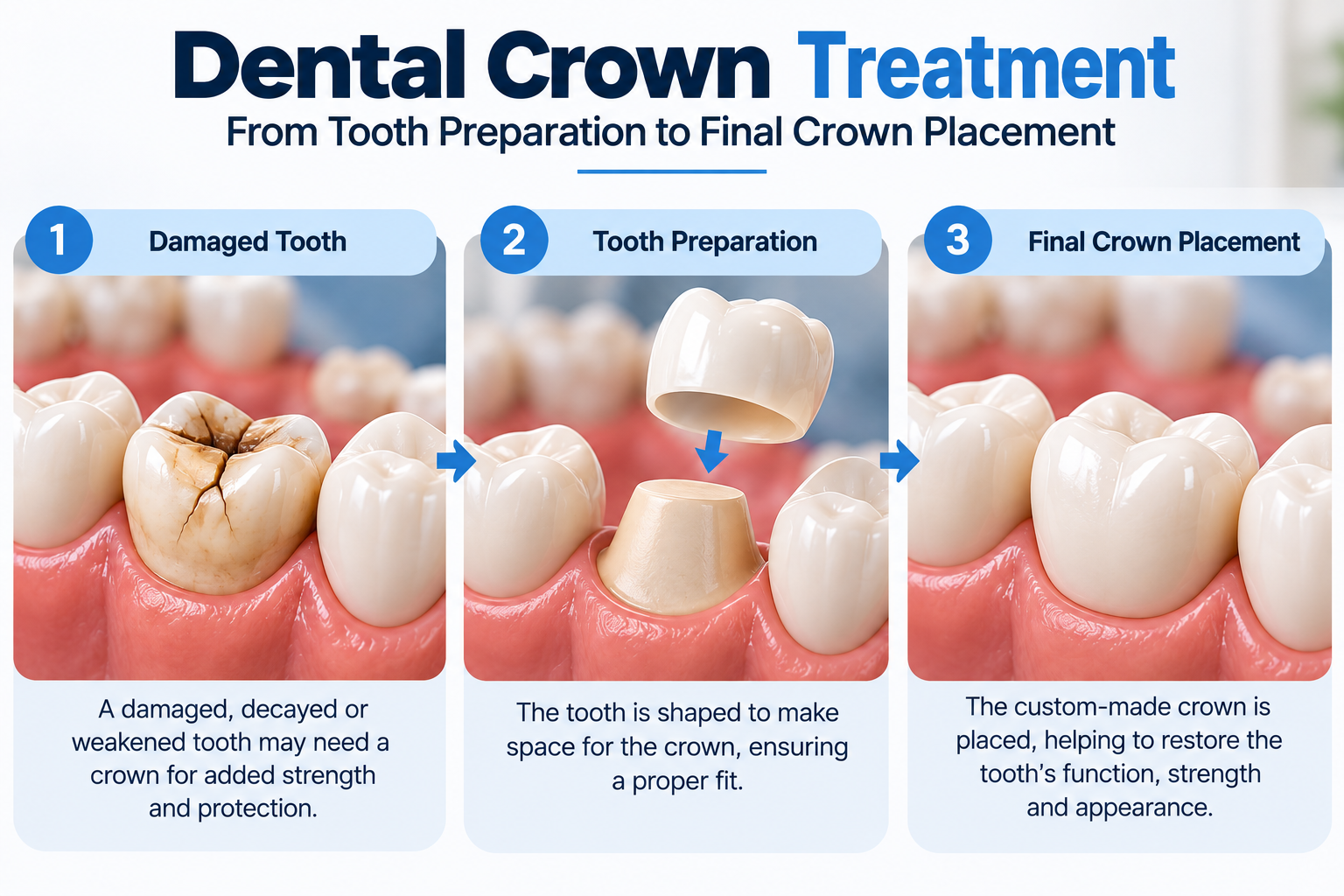
Step 1: Dental examination
The dentist first examines the tooth and evaluates the surrounding gums and teeth. Depending on the situation, dental X-rays may also be recommended.
This assessment helps determine whether a crown is suitable and whether any underlying dental problem needs to be treated first.
Step 2: Tooth preparation
If a crown is appropriate, the tooth is prepared so that the restoration can fit properly. The amount of preparation depends on the condition and type of tooth.
Step 3: Crown fabrication
Measurements or digital impressions may be taken so that the crown can be designed to fit the tooth accurately.
The selected material depends on factors such as the location of the tooth, functional requirements, appearance and clinical recommendation.
Step 4: Crown placement
Once the crown is ready, it is checked for fit, appearance and bite. After the necessary adjustments, it is placed over the prepared tooth.
The goal is to achieve a comfortable restoration that functions properly with the surrounding teeth.
What Types of Dental Crowns Are Available?
Different crown materials are available, and the appropriate option depends on the individual case.
Ceramic or all-ceramic crowns
These crowns can provide a natural-looking appearance and may be considered when aesthetics are an important factor.
Zirconia crowns
Zirconia is a strong ceramic material that can be used for different types of dental restorations. Its suitability depends on the tooth and the patient's treatment requirements.
Metal-based crowns
Metal-based restorations have traditionally been used because of their strength and durability. However, their appearance may be less similar to natural teeth.
Porcelain-fused-to-metal crowns
These restorations combine a metal structure with a tooth-coloured outer layer and may be considered for certain clinical situations.
Your dentist can explain the available options and recommend a material based on the location and condition of the tooth.
Dental Crown vs Dental Filling: What's the Difference?
A dental filling is generally used to repair a tooth with a smaller or moderate amount of damage.
A dental crown covers the visible portion of a tooth and may be recommended when the tooth has lost substantial structure or needs additional protection.
The choice between a filling and crown should be based on the condition of the tooth rather than simply the size of the cavity.
Is a Crown Needed After Every Root Canal?
Not necessarily.
Whether a crown is recommended after Root Canal Treatment depends on factors such as the amount of remaining tooth structure, the location of the tooth and the forces placed on it during chewing.
Molars and premolars, for example, generally experience significant chewing forces, so additional protection may be considered when appropriate.
A dental examination is necessary to determine the right restoration for an individual tooth.
How Should You Care for a Dental Crown?
A crowned tooth still requires regular oral care.
Follow these basic habits:
-
Brush your teeth twice a day with fluoride toothpaste.
-
Clean between your teeth regularly.
-
Avoid using your teeth to open packages or bite hard objects.
-
Follow your dentist's instructions after crown placement.
-
Attend regular dental check-ups.
-
Contact your dentist if the crown becomes loose, damaged or uncomfortable.
Although a crown protects the tooth, the tooth and surrounding gums can still develop problems without proper oral hygiene.
Can a Dental Crown Look Like a Natural Tooth?
Modern dental crowns can be designed to closely match the appearance of surrounding teeth.
The final appearance depends on factors including the crown material, colour selection, tooth position and individual dental characteristics.
For visible teeth, your dentist can discuss options that focus on achieving a natural-looking result while also meeting functional requirements.
Does Getting a Dental Crown Hurt?
The procedure is generally performed with appropriate local anaesthesia when tooth preparation is required.
Some patients may experience temporary sensitivity or mild discomfort after treatment. If pain or sensitivity persists or becomes significant, it is important to contact the treating dentist for evaluation.
How Long Can a Dental Crown Last?
The lifespan of a dental crown can vary from person to person.
Factors such as oral hygiene, chewing habits, crown material, tooth condition and regular dental care can influence its longevity.
Maintaining good oral hygiene and attending regular dental examinations can help protect both the crown and the underlying tooth.
Why Is Dental Evaluation Important Before Crown Treatment?
A crown should not be considered simply because a tooth looks damaged.
The dentist needs to assess the underlying tooth, gums, bite and surrounding structures before deciding whether a crown is appropriate.
If the tooth has an infection, gum disease or another underlying problem, that condition may need to be addressed before the final restoration is placed.
Dental Crown Treatment in Delhi
If you are searching for Dental Crown Treatment in Delhi, Aledentz Dental & Medical Center Delhi NCR provides dental evaluation and treatment planning for damaged, weakened and restored teeth.
The clinic provides a range of dental treatments, including Crowns & Bridges, Root Canal Treatment, Dental Implants, Tooth Filling, Gum Treatment and orthodontic care.
Treatment is planned according to the individual condition of the tooth rather than using the same approach for every patient.
For patients in West Delhi, Aledentz serves areas around Mahavir Enclave and Uttam Nagar through its two clinic locations.
Frequently Asked Questions
1. What is a dental crown?
A dental crown is a custom-made restoration that covers a damaged or weakened tooth to help restore its shape, strength and function.
2. When is a dental crown recommended?
A crown may be recommended for a severely damaged, cracked or weakened tooth, after certain Root Canal Treatments, or when a large filling has left the tooth structurally weak.
3. Is a dental crown the same as a filling?
No. A filling repairs a portion of a damaged tooth, while a crown covers the visible portion of the tooth and can provide additional structural protection.
4. Do I always need a crown after RCT?
No. The need for a crown depends on the condition and remaining structure of the tooth, its location and other clinical factors.
5. Can a dental crown look natural?
Yes. Several crown materials can be selected to provide a natural-looking appearance. Your dentist can recommend an appropriate option based on your tooth and treatment requirements.
6. How do I know if I need a dental crown?
A dental examination is the best way to determine whether a crown is appropriate. Your dentist may also recommend an X-ray depending on the condition of the tooth.
7. Can I eat normally after getting a crown?
Your dentist will provide specific instructions depending on the type of restoration and the stage of treatment. Once the final crown is properly placed, it is designed to function with normal chewing.
Conclusion
A damaged or weakened tooth does not always mean that the tooth has to be removed. When appropriate, a dental crown can help restore the tooth and protect the remaining natural structure.
If you have a broken tooth, extensive decay, a large filling or a tooth that has undergone Root Canal Treatment, a professional dental examination can help determine whether a crown is suitable for you.
For dental crown consultation and treatment planning in Delhi, you can contact Aledentz Dental & Medical Center Delhi NCR.
Clinic Locations
Mahavir Enclave
A-222, 40 Feet Road, Mahavir Enclave Part-2, New Delhi – 110059
Phone: 8376886885
Uttam Nagar
Plot No-62, Balaji Chowk, Mohan Garden, Uttam Nagar West, New Delhi – 110059
Phone: 7860925143
Website: www.aledentz.com